
Turning Clicks Into Conversions
A lead-generation landing system for service businesses
- Type
- Self-initiated concept
- Discipline
- Lead capture & automation
- Live build
- SEO Agency demo

01Introduction
Most small-business websites look fine but quietly leak enquiries: slow pages, unclear next steps and forms that vanish into an inbox nobody checks. This study explores a landing system designed around one job — turning paid and organic visits into qualified conversations.
02Challenge
Service businesses often run ads to a generic homepage. Visitors arrive with a specific intent, find a menu of everything, and leave. When someone does fill in a form, the submission lands in email with no context, no follow-up and no way to tell which campaign produced it.
03Objectives
- One focused page per offer, with a single primary action above the fold
- Sub-second loads on mid-range mobile devices
- Every enquiry captured with its source, validated, and routed automatically
- An instant, honest confirmation so prospects know what happens next
04Approach
Map the intent
Each traffic source is paired with the question the visitor arrives with, and the page answers it in the first screen.
Reduce friction
Forms ask only for what is needed to start a conversation; optional detail is collected later.
Automate the hand-off
Submissions are validated on the server, tagged with campaign data and pushed to the CRM through a webhook.
05How it works
The request flow behind this concept. Choose a step to read what happens at each layer; the diagram is an illustration of the approach, not a deployed client system.
Concept architecture · illustrative
01 · Campaign visitSomeone clicks a campaign ad for emergency repairs.
06Design & development
The page is statically generated, so the hero, proof points and form render instantly from the edge. The form is progressively enhanced: it works without JavaScript and upgrades to inline validation when scripts load.
On the server, a single validation schema guards the endpoint. A honeypot field and per-IP rate limiting keep spam out without adding a CAPTCHA that costs conversions.
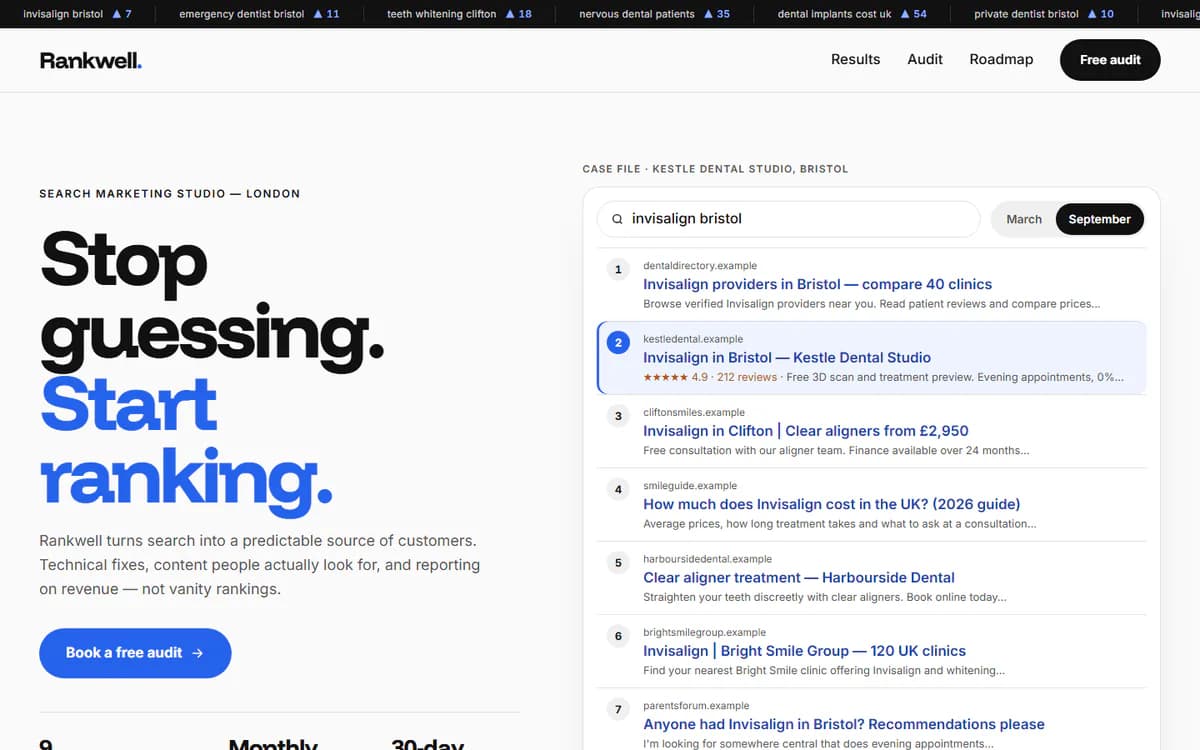
Related live buildSEO Agency demoEditorial, type-led search agency site with a bold headline, proof numbers, services and a four-step process.Open the demo07Technologies
08Final solution
The result is a reusable landing template that can be cloned per campaign in minutes, with attribution and lead routing built in. The SEO Agency demo applies the same structure: a focused hero, scannable proof and a clear call to action.
Explore the live demoThis is a self-initiated concept study by Straux Technologies. It does not describe work for a client, and no commercial results are claimed.